
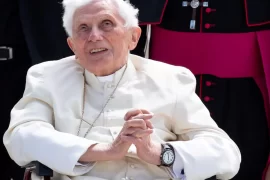
Pope Benedict XVI has died at his residence in The Vatican.
Advertisement
The Former Pope was born Joseph Aloisius Ratzinger on 16 April 1927 and died on 31 December 2022. He was 95 years old.
Pope Benedict was the head of the Catholic Church and sovereign of the Vatican City State from 19 April 2005 until his resignation on 28 February 2013.
Why did Pope Benedict change his name?

Image Credit: DW.com
In his first general audience, after being crowned Pope which was held at the St. Peter’s Square in the presence of 15,000 people, the Pope again gave thanks to God for having elected him as Peter’s successor, and explained why he chose the name of Benedict.
Portions of Pope Benedict’s statement reads:
“Awe and gratitude to God, Who surprised me more than anyone in calling me to succeed the Apostle Peter; and interior trepidation before the greatness of the task and the responsibilities which have been entrusted to me.
“However, I draw serenity and joy from the certainty of God’s help, that of His most Holy Mother the Virgin Mary, and of the patron saints. I also feel supported by the spiritual closeness of all the people of God whom, as I repeated last Sunday, I continue to ask to accompany me with persistent prayer.
Advertisement
“I wish to speak of the name I chose on becoming bishop of Rome and pastor of the universal Church.”
“I chose to call myself Benedict XVI ideally as a link to the venerated Pontiff, Benedict XV, who guided the Church through the turbulent times of the First World War.
“He was a true and courageous prophet of peace who struggled strenuously and bravely, first to avoid the drama of war and then to limit its terrible consequences.
“In his footsteps I place my ministry, in the service of reconciliation and harmony between peoples, profoundly convinced that the great good of peace is above all a gift of God, a fragile and precious gift to be invoked, safeguarded and constructed, day after day and with everyone’s contribution.
“The name Benedict also evokes the extraordinary figure of the great ‘patriarch of western monasticism,’ St. Benedict of Norcia, co-patron of Europe with Cyril and Methodius.
“The progressive expansion of the Benedictine Order which he founded exercised an enormous influence on the spread of Christianity throughout the European continent.
“For this reason, St. Benedict is much venerated in Germany, and especially in Bavaria, my own land of origin; he constitutes a fundamental point of reference for the unity of Europe and a powerful call to the irrefutable Christian roots of European culture and civilization.”
Leave a Reply