
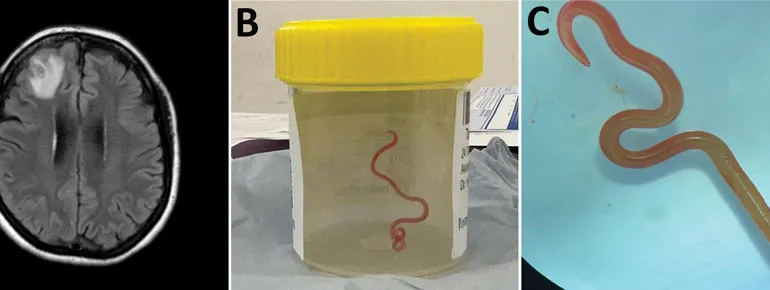
What worm was found in the Australian woman’s brain? How did the worm get into the Australian woman’s brain?
Advertisement
In a shocking medical revelation, an Australian woman’s recent health ordeal has brought to light a rare and perplexing case of a parasitic worm found residing within her brain. The identified culprit, known as Ophidascaris robertsi, is a species of roundworm typically found in pythons, raising questions about how this creature managed to take up residence in a human brain. The discovery was made by medical experts at the Australian National University and the Canberra Hospital, who have been working to unravel the mysterious circumstances surrounding this bizarre case.
The journey of this parasitic invader from the wild to a human brain is an extraordinary tale of nature’s intricate interplay. According to Dr. Jay Senanayake, a spokesperson for the medical team investigating the case, the worm in question is believed to have embarked on its unlikely journey through a series of steps, each more astounding than the last.
In its natural lifecycle, Ophidascaris robertsi is known to lay its eggs on the dura mater, the tough outermost layer of the meninges that envelop the brain and spinal cord. Alternatively, the adult worms can introduce their eggs directly into the bloodstream of their primary host, which, in this case, are deer. These eggs hatch into larvae that enter the deer’s bloodstream, paving the way for a sinister journey of infection.
Advertisement
So, how did this parasitic traveler end up in the brain of an Australian woman? It is hypothesized that the woman inadvertently consumed the worm eggs, following a mechanism similar to how small animals typically become infected. The local environment near the woman’s residence appears to hold the key to this perplexing enigma. Carpet pythons, natural carriers of Ophidascaris robertsi, were found near a lake area close to the woman’s home. It’s conceivable that the woman may have ingested the microscopic eggs through contaminated water or food, setting off a chain of events that would lead to the unprecedented presence of a python-associated roundworm within her brain.
Dr. Senanayake highlighted the critical role of collaboration and advanced medical technology in solving this medical riddle. The live worm was sent to an expert, who quickly identified it as Ophidascaris robertsi through visual inspection. Subsequent molecular tests not only confirmed the identification but also shed light on the peculiar origin of this unwanted guest within the woman’s brain.
Cases of parasitic infections in humans often astonish with their complexity and the unexpected pathways these creatures take to establish their presence. This unique instance underscores the intricate relationships between different species in the natural world, often culminating in surprising and rarely witnessed outcomes. The medical team’s efforts in diagnosing and understanding this case exemplify the dedication and ingenuity of the scientific community in grappling with nature’s most baffling puzzles.
As the Australian woman continues her journey to recovery, her extraordinary encounter with the elusive Ophidascaris robertsi serves as a stark reminder of the mysterious ways in which the natural world can intersect with human lives.
Leave a Reply