
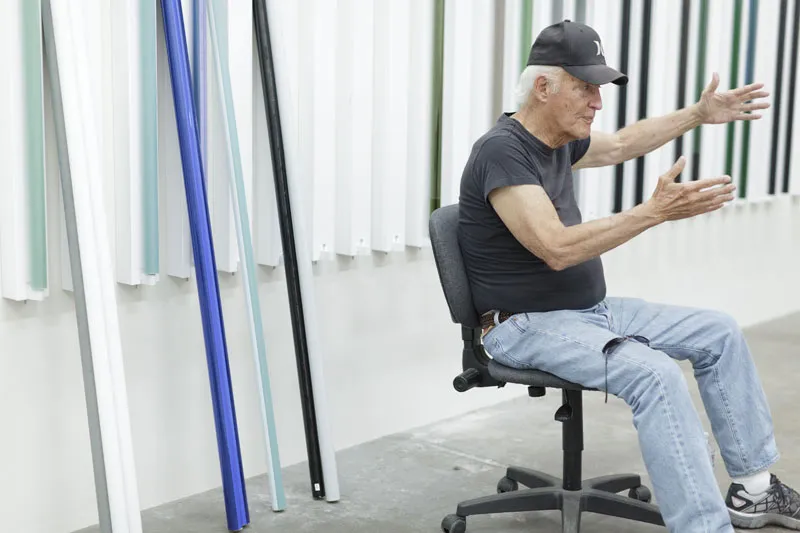
Robert Irwin was a pioneer whose work helped to define the aesthetics and conceptual issues of the West Coast Light and Space movement. His early works often employed light and veils of scrim to transform gallery and museum spaces, but from 1975 until his death, he also incorporated landscape projects into his practice.
Advertisement
Robert Irwin conceived over fifty-five site-specific projects, at institutions including the Getty Center (1992–98), Dia:Beacon (1999–2003), and the Chinati Foundation in Marfa, Texas (2001–16).
The Museum of Contemporary Art, Los Angeles mounted the first retrospective of his work in 1993; in 2008, the Museum of Contemporary Art San Diego presented another, spanning fifty years of his career.
Advertisement

Robert Irwin received a Guggenheim Fellowship in 1976, a MacArthur Fellowship in March 1984, and was elected as a member of the American Academy of Arts and Letters in 2007.
Between the years 1957 and 1958, Robert W. Irwin taught at the Chouinard Art Institute. His early works often employed light and veils of scrim to transform gallery and museum spaces. But from 1975 until his death, Robert W. Irwin also incorporated landscape projects into his practice.
Leave a Reply