
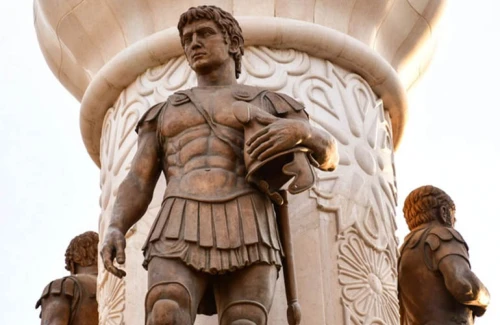
Alexander the Great, a legendary figure in history, is renowned for his unparalleled military conquests and his role in shaping the Hellenistic world.
Advertisement
Born in Pella, the ancient capital of Macedonia, in 356 BCE, Alexander, the son of King Philip II, ascended to the throne at the young age of 20 after his father’s assassination.
What sets Alexander apart and secures his place in history is his extraordinary military prowess. He embarked on a relentless campaign of conquest that spanned over a decade, creating one of the largest empires the world had ever seen.
His military strategy, marked by innovation and boldness, allowed him to conquer vast territories, stretching from Greece to Egypt, and as far east as India.
One of Alexander’s most celebrated achievements was the defeat of the formidable Persian Empire. In 334 BCE, he crossed the Hellespont into Asia Minor, engaging in a series of battles that culminated in the Battle of Issus in 333 BCE.
The victory over Darius III established Alexander’s reputation as a military genius and marked the beginning of his eastward expansion.
Advertisement

The legendary military campaign continued with the conquest of Egypt in 332 BCE, where he founded the city of Alexandria. His influence on the regions he conquered extended beyond military dominance, as he sought to integrate and assimilate Persian and Greek cultures, fostering a sense of unity among his diverse subjects.
The pinnacle of Alexander’s conquests was his expedition into the Indian subcontinent. The Battle of Hydaspes in 326 BCE, where he faced the formidable Indian king Porus, showcased his tactical brilliance.
However, the prolonged campaigns and the weariness of his troops led Alexander to reluctantly turn back, marking the limits of his vast empire.
Beyond his military achievements, Alexander left an enduring legacy in the realms of culture and knowledge. His tutor, the philosopher Aristotle, imparted upon him a love for learning, and as he journeyed through the conquered territories, he carried with him scholars and scientists who contributed to the exchange of ideas between East and West.
Despite his remarkable achievements, Alexander’s life was cut short. He succumbed to illness in Babylon in 323 BCE, leaving a legacy that reverberated through the ages. His death marked the beginning of the Hellenistic period, where the fusion of Greek and Eastern cultures continued to shape the world.
Leave a Reply