
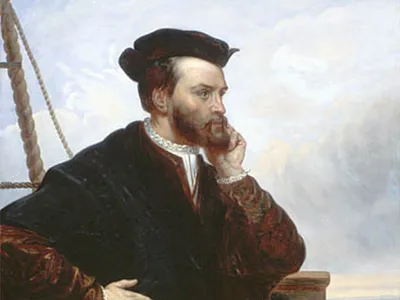
The Age of Exploration birthed a cadre of intrepid navigators, and among them, Jacques Cartier stands as a figure whose contributions shaped the map of North America. Yet, as with many historical figures, Cartier’s legacy is multifaceted, leaving us to ponder: What happened to Jacques Cartier, and is he to be considered a hero?
Advertisement
A Pioneer of Exploration:
Born on December 23, 1491, in Saint-Malo, France, Jacques Cartier emerged as the first European to meticulously describe and map the Gulf of Saint Lawrence and the shores of the Saint Lawrence River. His expeditions to the New World laid the groundwork for future European exploration and colonization.
Later Years and Contributions:
After his voyages, Cartier returned to Saint-Malo and his nearby estate, where he found purpose as an interpreter in Portuguese. His linguistic skills made him a valuable asset, bridging communication between different cultures in an era marked by global exploration and interaction.
The End of an Era:
Jacques Cartier’s journey, however, came to an end on September 1, 1557, at the age of 65. His passing occurred during an epidemic, possibly attributed to typhus, although the exact cause of death remains a matter of historical ambiguity.
The Question of Heroism:
Advertisement
The evaluation of Cartier’s legacy has evolved. Until the end of the eighteenth century, historians acknowledged his navigational achievements but did not elevate him to the status of a hero in the history of New France. The complex nature of exploration, colonization, and encounters with Indigenous peoples contributed to a nuanced understanding of Cartier’s role in history.
Interpreting Jacques Cartier’s Legacy:
The question of whether Jacques Cartier is to be considered a hero is subjective and depends on one’s perspective. While his contributions to exploration are undeniable, the broader context of the consequences of European exploration, including the impact on Indigenous peoples, adds layers of complexity to his legacy.
A Legacy in Flux:
As historical perspectives shift, so do figures like Jacques Cartier. Modern evaluations consider the full scope of his impact, acknowledging both his navigational prowess and the broader implications of European exploration in the New World.
Jacques Cartier’s life encapsulates the intricate tapestry of exploration, cultural exchange, and the consequences of encounters between worlds. His legacy, once overlooked in the heroics of New France, is now reexamined with a nuanced understanding of the complexities of history. As we ponder what happened to Jacques Cartier, we navigate through the layers of his legacy, recognizing that the interpretation of historical figures is an ever-evolving process that invites reflection and discussion.
Leave a Reply