
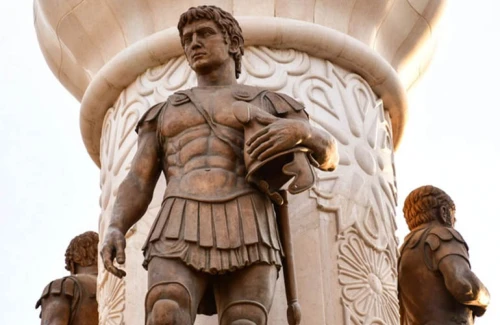
Alexander the Great, the renowned king of Macedon, met his untimely demise at the young age of 32.
Advertisement
His death occurred on either the 10th or 11th of June 323 BC, within the opulent confines of Nebuchadnezzar II’s palace in Babylon. The circumstances surrounding Alexander’s death have been narrated in different versions, each providing slight variations in the details.
According to the account provided by Plutarch, approximately 14 days before his passing, Alexander engaged in festivities with admiral Nearchus, spending the night and the subsequent day reveling with Medius of Larissa.
The celebratory atmosphere took a somber turn as Alexander succumbed to a debilitating fever, rendering him unable to articulate words. In a poignant gesture, recognizing the concern of his common soldiers about his failing health, Alexander allowed them to file past him as he silently acknowledged them with a wave.
Advertisement

A second narrative, as recounted by Diodorus, presents an alternate sequence of events. In this version, Alexander experienced excruciating pain after consuming a large bowl of unmixed wine in homage to Heracles.
This ordeal persisted for 11 days, and contrary to the fever mentioned in Plutarch’s account, Alexander met his end after enduring a period of agony.
Arrian, while acknowledging this alternative version, pointed out that Plutarch explicitly refuted the claim that Alexander’s demise was linked to the consumption of unmixed wine.
The differing accounts add an air of mystery to the circumstances surrounding the death of the great conqueror, leaving historians with some ambiguity regarding the exact nature of the events leading to his passing.
Regardless of the particulars, what remains indisputable is that Alexander the Great, a figure of immense historical significance, breathed his last at the relatively young age of 32, leaving behind a legacy that would endure through the ages.
Leave a Reply