
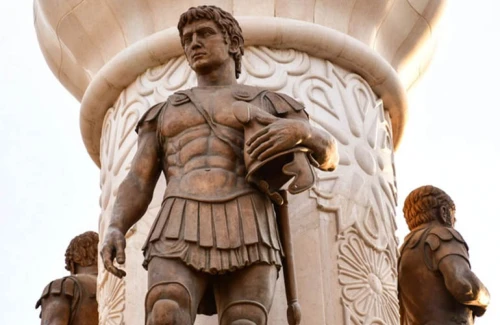
Alexander the Great, one of history’s most celebrated military tacticians and conquerors, embarked on an extraordinary campaign that reshaped the geopolitical landscape of the ancient world.
Advertisement
Born in 356 BC in Pella, the capital of Macedon, Alexander ascended to the throne after the assassination of his father, King Philip II, in 336 BC. With ambitions beyond the borders of Macedon, he undertook an epic military expedition that would ultimately lead to the conquest of a vast swath of territory.
His march of conquest from Greece included Anatolia, Syria, Phoenicia, Egypt, Mesopotamia, Persia, Afghanistan, and India. He expanded the Macedonian Empire as far east as the city of Taxila in modern-day Pakistan.
Alexander’s conquests commenced in 334 BC with the invasion of the Achaemenid Persian Empire, then ruled by Darius III. The Battle of Granicus marked his initial victory, opening the gateway to Asia Minor. Subsequent campaigns in Anatolia witnessed Alexander’s strategic brilliance as he triumphed over Persian forces in key battles such as Issus in 333 BC.

Continuing eastward, Alexander entered Egypt in 332 BC, where he was welcomed as a liberator by the Egyptians who resented Persian rule. The city of Alexandria, founded by Alexander, would later become a beacon of Hellenistic culture and a center of learning.
Advertisement
The pinnacle of Alexander’s conquests occurred with the invasion of Persia itself. The decisive Battle of Gaugamela in 331 BC proved instrumental, resulting in the fall of Darius III and solidifying Alexander’s dominance over the Persian Empire.
Undeterred, Alexander pressed on into Central Asia, crossing the arduous terrain of the Hindu Kush and entering the Indian subcontinent. The Battle of Hydaspes in 326 BC marked a formidable encounter against King Porus, showcasing Alexander’s tactical prowess.
In response to his army’s weariness, Alexander reluctantly agreed to turn back, beginning the return journey to Babylon in 325 BC. However, his plans for further conquests were curtailed by his untimely death in 323 BC at the age of 32.
While Alexander’s empire was expansive, it is important to note that the concept of “conquering” in the ancient world did not necessarily entail direct governance.
Many regions within the empire retained a degree of autonomy, and the Macedonian influence was often established through military might and cultural assimilation rather than strict administrative control.
Leave a Reply