
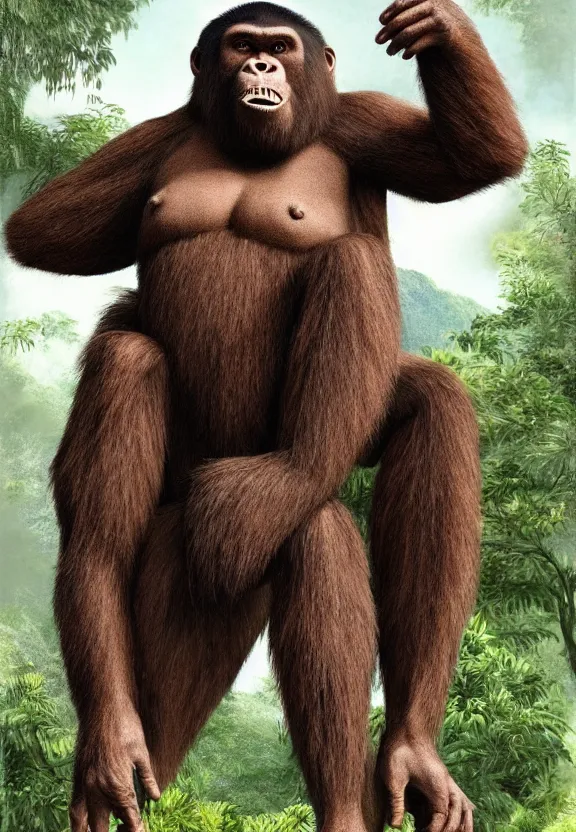
In Gigantopithecus’ locomotion, the fossil evidence presents a tantalizing puzzle for scientists.
Advertisement
The limitations of available fossils shroud the giant ape’s walk in uncertainty, leaving researchers to unravel its mysteries through a blend of anatomical analysis and comparisons with its living kin.
Exploring the possibilities, the suggestion of knuckle-walking arises, echoing the familiar gait of modern apes.
Adaptations in finger bones and wrist structure hint at an efficient means for navigating uneven landscapes and foraging in the dense forests that once housed this colossal creature.
Bipedalism, though less probable, emerges as a speculative stride in the Gigantopithecus saga.
Advertisement

Photo via Reddit
Robust leg bones and subtle hints of an upright posture propose occasional bipedal strolls, reminiscent of their distant cousins, the bonobos. Yet, the enormity of Gigantopithecus and the absence of distinct bipedal adaptations make this an intriguing but unlikely primary mode of movement.
In the grand tapestry of locomotion, a mixed repertoire unfolds. Knuckle-walking for practical travel, sporadic bipedalism for short bursts or reaching lofty perches, and perhaps even a venture into river currents – where their size wouldn’t hinder aquatic agility – all paint a diverse picture of how Gigantopithecus navigated its world.
As our understanding evolves with each new fossil discovery and advancing analytical techniques, the fog surrounding Gigantopithecus’ walk gradually lifts.
This enigmatic giant beckons us to explore the lost realms it once roamed, reminding us that within the gaps of knowledge, the allure of imagination persists.
Leave a Reply