
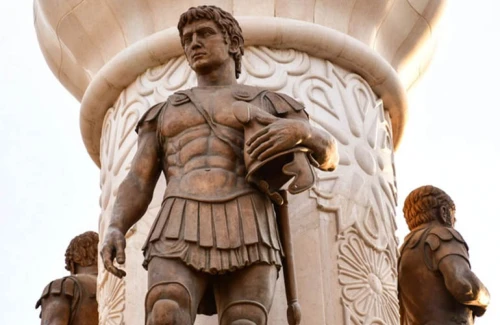
Alexander III of Macedon, renowned as Alexander the Great, left an indelible mark on ancient history through his conquests and visionary leadership.
Advertisement
However, the circumstances surrounding his untimely death have been shrouded in mystery and debated by historians for centuries.
On either June 10 or 11, 323 BC, Alexander breathed his last breath in the opulent palace of Nebuchadnezzar II in Babylon, marking the end of an era. The details of his demise, however, are subject to differing accounts, adding an air of intrigue to the final chapter of this extraordinary ruler.
One version of Alexander’s death, as chronicled by the historian Plutarch, unfolds with a social gathering. Approximately 14 days before his demise, Alexander entertained Admiral Nearchus and engaged in a night of revelry with Medius of Larissa.
A fever seized him, intensifying until he could no longer articulate words. As his soldiers anxiously gathered, they were granted the poignant privilege of filing past their ailing leader, who silently acknowledged them with a feeble wave.
Advertisement

Contrastingly, another narrative presented by Diodorus portrays a different sequence of events. Alexander, after consuming a substantial bowl of unmixed wine in honor of Heracles, experienced excruciating pain.
This agony persisted for 11 days, culminating in his eventual death. Notably, this account dismisses the development of a fever, introducing a distinct perspective on the ruler’s final days.
Arrian, acknowledging this alternative version, emphasizes Plutarch’s rejection of the unmixed wine claim, further deepening the historical ambiguity surrounding Alexander’s death.
Following his demise, Alexander’s body underwent a remarkable preservation process. Encased in a gold anthropoid sarcophagus, his remains were immersed in honey, ensconced within a grand gold casket.
The death of Alexander the Great remains enigmatic, a captivating historical puzzle with divergent narratives. Whether succumbing to a fever after nights of revelry or enduring prolonged agony after imbibing unmixed wine, Alexander’s demise is forever etched in the annals of history, leaving a legacy as profound as the conquests that defined his life.
Leave a Reply