
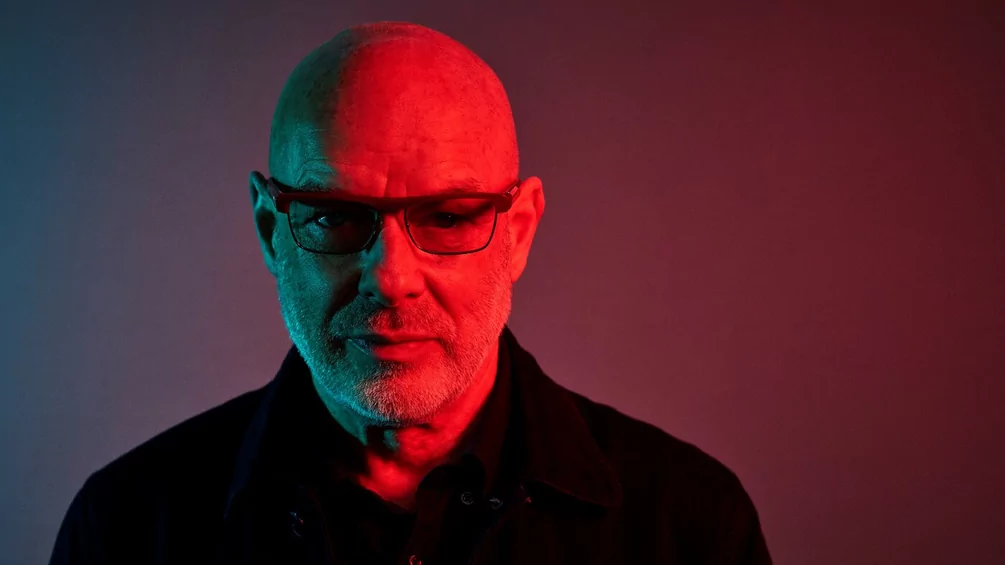
Brian Eno stands as a musical luminary, known for his groundbreaking contributions to ambient music and his versatile talents as a composer, record producer, singer, and visual artist. Born in Woodbridge, England, Eno’s journey from his early years to his influential career has left an indelible mark on the world of music.
Advertisement
Early Life and Education:
Growing up in Suffolk, Eno received his formal education at St Joseph’s College in Ipswich, later attending Ipswich Art School and Winchester School of Art. Inspired by a lecture by Pete Townshend, Eno’s fascination with non-musicians using tape machines marked the beginning of his musical exploration.

Image Credit: MixMag
Career with Roxy Music:
Eno’s professional music career took off when he joined the glam rock band Roxy Music in 1971. Operating the mixing desk, processing the band’s sound, and contributing vocals, Eno played a pivotal role. However, his time with Roxy Music was short-lived, and he left the group in 1973.
Solo Ventures and Ambient Music:
From 1973 to 1977, Eno embarked on a solo career, releasing albums such as ‘Here Come the Warm Jets,’ ‘Taking Tiger Mountain,’ ‘Another Green World,’ and ‘Before and After Science.’ Notably, his collaboration with Robert Fripp led to the creation of the ambient music genre with albums like ‘Discreet Music’ in 1975 and the Ambient series.
Ambient music, characterized by low-volume compositions that alter one’s perception of the environment, became Eno’s signature contribution to the music world. The albums ‘Music for Airports,’ ‘The Plateaux of Mirror,’ ‘Day of Radiance,’ and ‘On Land’ further solidified his place as a pioneer of ambient soundscapes.
Diversification of Musical Styles:
Eno’s career witnessed diversification as he ventured into film scores, collaborating with David Byrne of Talking Heads for ‘My Life in the Bush of Ghosts’ in 1980. In the 1990s, he explored generative music, blending various tracks to create self-generating musical systems.
Collaborations and Continued Innovation:
Throughout his career, Eno collaborated with diverse artists, forming the group ‘Passengers’ in 1995 and working with Luciano Pavarotti and members of U2. His collaborations extended to Robert Fripp, resulting in albums like ‘The Equatorial Stars’ in 2004.
Eno’s contributions to film scores expanded with works like ‘The Lovely Bones in 2009. In 2010, he released ‘Small Craft on a Milk Sea,’ a solo album in collaboration with Leo Abrahams and Jon Hopkins.
Advertisement
Legacy and Continued Influence:
Beyond his role as a musician, Eno has made significant contributions as a producer, working with iconic bands such as Talking Heads, U2, Devo, Ultravox, and James. His influence extends to reissues, including the 25th-anniversary edition of ‘My Life in the Bush of Ghosts’ in 2006.
Brian Eno Age
How old is Brian Eno? Brian Eno was born on May 15, 1948.
Brian Eno Height
How tall is Brian Eno? Brian Eno stands at the height of 1.69m.
Brian Eno Nationality
Brian Eno is a musician.
Brian Eno Education
Brian Eno attended St Joseph’s College in Ipswich, a Catholic grammar school of the De La Salle Brothers Oder.
Brian Eno Songs
Here are some notable Brian Eno songs that showcase the breadth of his musical talent:
- “Baby’s on Fire” (from ‘Here Come the Warm Jets,’ 1973):
- A standout track from Eno’s debut solo album, featuring a distinctive guitar riff and Eno’s experimental approach to vocals.
- “St. Elmo’s Fire” (from ‘Another Green World,’ 1975):
- An ambient instrumental piece that captures Eno’s ability to create atmospheric and immersive soundscapes.
- “Music for Airports 1/1” (from ‘Music for Airports,’ 1978):
- Considered a seminal work in ambient music, this piece reflects Eno’s concept of creating music that can shape the atmosphere of a space.
- “By This River” (from ‘Before and After Science,’ 1977):
- A tranquil and introspective song that showcases Eno’s softer and melodic side.
- “Third Uncle” (from ‘Taking Tiger Mountain (By Strategy),’ 1974):
- A more rock-oriented track with a driving beat, demonstrating Eno’s versatility across different musical styles.
- “Deep Blue Day” (from ‘Apollo: Atmospheres and Soundtracks,’ 1983):
- Created in collaboration with Daniel Lanois and Roger Eno, this song is part of the soundtrack for the documentary ‘For All Mankind.’
- “An Ending (Ascent)” (from ‘Apollo: Atmospheres and Soundtracks,’ 1983):
- A beautiful ambient composition that has been widely used in films, documentaries, and commercials.
- “Television” (from ‘Another Day on Earth,’ 2005):
- A later work that showcases Eno’s continued exploration of electronic and ambient textures.
- “The Big Ship” (from ‘Another Green World,’ 1975):
- An instrumental piece that builds a sense of grandeur and emotion through layered synthesizers.
- “Spinning Away” (with John Cale, from ‘Wrong Way Up,’ 1990):
- A collaborative effort with John Cale, blending Eno’s electronic sensibilities with Cale’s distinctive vocals.
Leave a Reply