

The James Webb Space Telescope (JWST) is a space telescope primarily designed for infrared astronomy.
Advertisement
The first set of full-resolution science images from the James Webb Space Telescope was released on July 12.
This collection included images of the Carina Nebula, the Eight-Burst Nebula, Stephan’s Quintet, and a galaxy cluster stretching the light of the objects behind it, as well as an analysis of the composition of an exoplanet called WASP-96b.
Advertisement
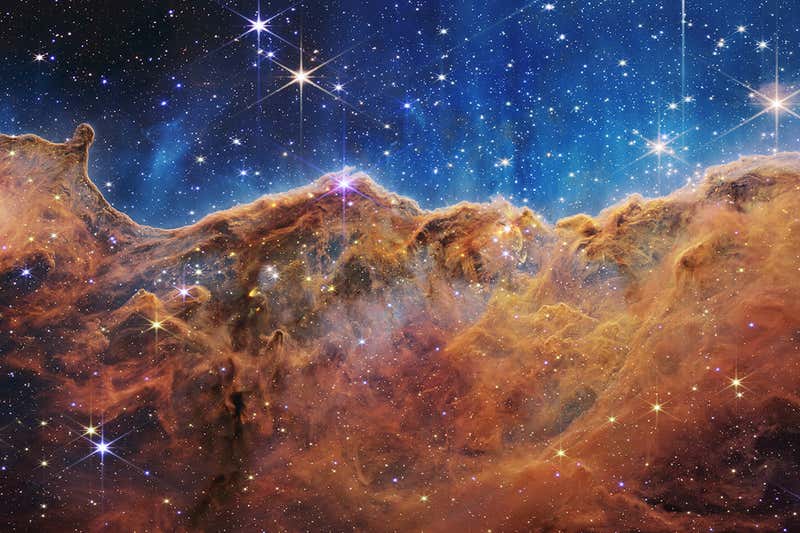
NASA, ESA, CSA, STScI
How many light years away will the James Webb telescope see?
The James Webb Space Telescope should be able to see 100 to 250 million years after the big bang! But, while that is up to about 13.7 billion years ago, it is not 13.7 billion light years away it is much further because of the universe’s expansion.
The JWST’s primary mirror is 6.5 metres (21 feet) in diameter and is made up of 18 separate hexagonal mirrors. The polished area of the mirror is 26.3 m2 (283 sq ft), with the secondary support struts obscuring 0.9 m2 (9.7 sq ft), for a total collecting area of 25.4 m2 (273 sq ft).
.
Leave a Reply