

The Webb telescope can see light with a longer wavelength than our eyes can because it is primarily an infrared telescope.
Advertisement
JWST should be able to observe between 100 and 250 million years after the Big Bang! Although that occurred up to approximately 13.7 billion years ago, it is much farther away than that because of the expansion of the universe; it is more than 13.7 billion light years away.
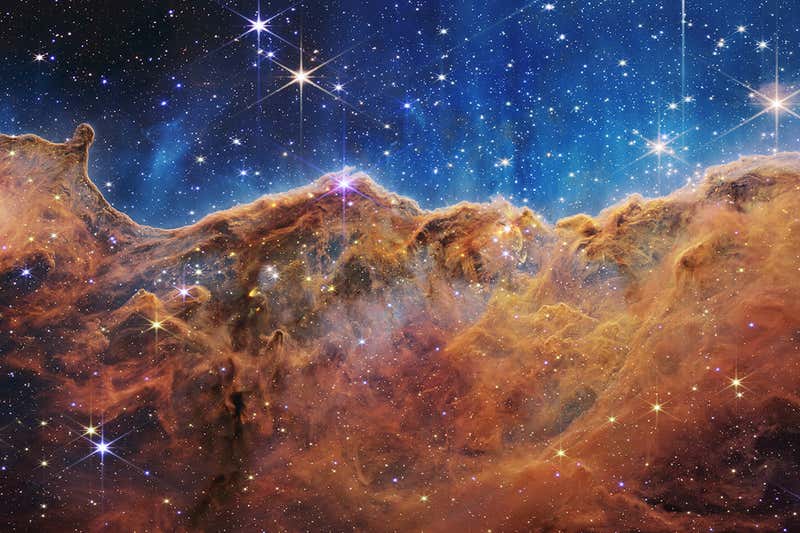
NASA, ESA, CSA, STScI
The mass of the James Webb Space Telescope is roughly equal to that of the Hubble Space Telescope. 18 distinct hexagonal mirrors make up the 6.5-meter (21-foot)-diameter primary beryllium mirror on the JWST.
Advertisement

The mirror has a polished area of 26.3 m2 (283 sq ft), but the secondary support struts obscure 0.9 m2 (9.7 sq ft), giving it a total collecting area of 25.4 m2 (273 sq ft).
This is more than six times bigger than the Hubble mirror’s 4.0 m2 collecting area, which has a 2.4 m (7.9 ft) diameter (43 sq ft).
Leave a Reply