
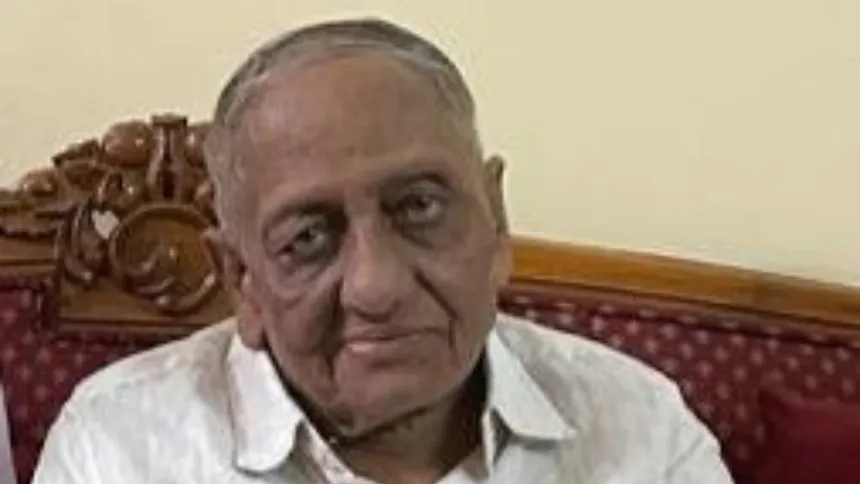
- Dr. Ram Narain Agarwal, a key architect of India’s long-range ballistic missile program, has passed away at the age of 83.
- He was instrumental in the development of the Agni series of missiles, earning him the title “Father of Agni Missiles” and the Padma Bhushan award.
- As the founder-director of the Advanced Systems Laboratory (ASL), he led India’s missile program for over two decades, working closely with eminent scientists like Dr. APJ Abdul Kalam.
- The Defence Research and Development Organisation (DRDO) paid tribute to his legacy, acknowledging his contributions to India’s defense technology.
Dr. Ram Narain Agarwal, a pioneering force in India’s missile technology and revered as the “Father of Agni Missiles,” died on Thursday in Hyderabad. He was 83.
Advertisement
Dr. Agarwal’s legacy is deeply intertwined with the success of India’s defense capabilities, particularly through his leadership in the development of the Agni series of long-range ballistic missiles. His role as the first Programme Director of the Agni missiles and founder-director of the Advanced Systems Laboratory (ASL) solidified his place as a cornerstone of India’s missile development efforts.

In recognition of his contributions to the nation’s defense, Dr. Agarwal was honored with prestigious awards, including the Padma Bhushan and Padma Shri. The Defence Research and Development Organisation (DRDO), where he spent a significant portion of his career, expressed their sorrow over his passing in a heartfelt post on X, formerly Twitter.
Advertisement
“With profound grief and sorrow, DRDO offers the condolence on the sad demise of Dr. Ram Narain Agarwal, an outstanding aerospace scientist and Padma Bhushan awardee, who was instrumental in the development of India’s long-range missile, Agni. May his soul rest in peace,” the DRDO’s statement read.
Over his illustrious 22-year career, Dr. Agarwal played a huge role in advancing India’s missile technology. He was responsible for pioneering innovations in re-entry technology, all-composite heat shields, onboard propulsion systems, and advanced guidance and control systems—technologies that have become foundational to India’s missile capabilities.
Dr. Agarwal’s work was particularly notable during his collaboration with other leading scientists of his time, including Dr. Arunachalam and the late Dr. APJ Abdul Kalam, the former President of India and a visionary in missile technology.
Together, they worked under the Integrated Guided Missile Development Programme (IGMDP), which was launched by the Indian government in 1983 with the ambitious goal of developing five key missile systems—Agni, Prithvi, Akash, Nag, and Trishul.
The Agni missile, the most ambitious of the five, stands as a testament to Dr. Agarwal’s expertise and dedication. His efforts not only advanced India’s defense capabilities but also positioned the country as a formidable player in global missile technology.
Leave a Reply