
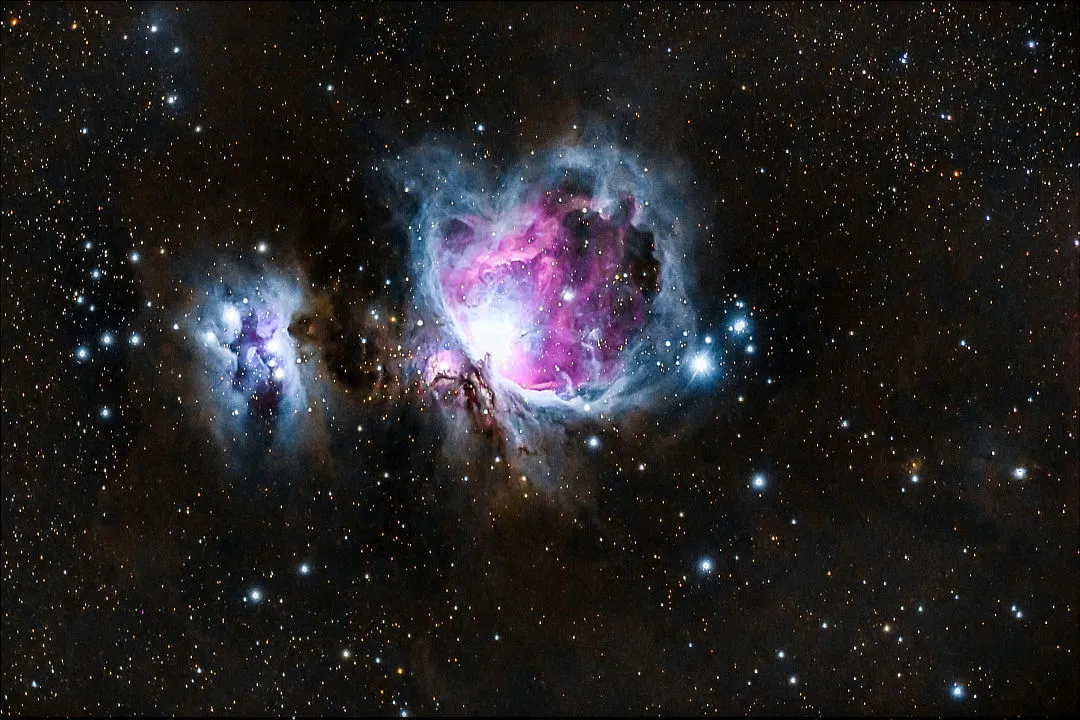
The Orion Nebula, also known as Messier 42, M42, or NGC 1976, is a diffuse nebula that is indeed located in the Milky Way galaxy. It is situated south of Orion’s Belt in the constellation of Orion and is known as the middle “star” in the “sword” of Orion.
Advertisement
The Orion Nebula is one of the brightest nebulae and is visible to the naked eye in the night sky with an apparent magnitude of 4.0. It is approximately 1,344 ± 20 light-years (412.1 ± 6.1 parsecs) away from Earth and is the closest region of massive star formation to Earth. The M42 nebula is estimated to be 24 light-years across, so its apparent size from Earth is approximately 1 degree. It has a mass of about 2,000 times that of the Sun.

The Orion Nebula is one of the most scrutinized and photographed objects in the night sky and is among the most intensely studied celestial features. The nebula has revealed much about the process of how stars and planetary systems are formed from collapsing clouds of gas and dust. Astronomers have directly observed protoplanetary disks and brown dwarfs within the nebula, intense and turbulent motions of the gas, and the photo-ionizing effects of massive nearby stars in the nebula.
Advertisement
The Orion Nebula is visible with the naked eye even from areas affected by some light pollution. It is seen as the middle “star” in the “sword” of Orion, which are the three stars located south of Orion’s Belt. The “star” appears fuzzy to sharp-eyed observers, and the nebulosity is obvious through binoculars or a small telescope.
The Orion Nebula contains a very young open cluster, known as the Trapezium Cluster due to the asterism of its primary four stars within a diameter of 1.5 light years. Two of these can be resolved into their component binary systems on nights with good seeing, giving a total of six stars.
In conclusion, the Orion Nebula is a fascinating celestial object that is located in our Milky Way galaxy. Its location and visibility make it a popular object for both professional astronomers and amateur stargazers to observe and study.
Leave a Reply