
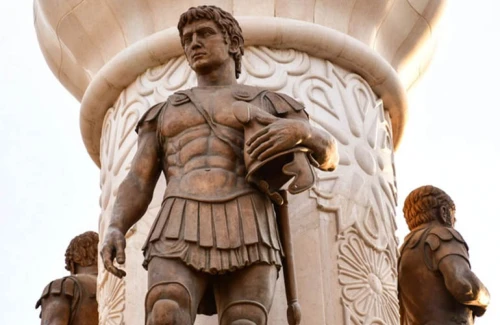
Alexander III of Macedon, widely celebrated as Alexander the Great, left an indelible mark on history through his unprecedented conquests.
Advertisement
However, his legacy extends beyond his own accomplishments, encompassing the tragic tale of his successor and son, Alexander IV of Macedon.
Born to Alexander the Great and his wife Roxana, Alexander IV entered a world fraught with political turmoil and uncertainty. His birth, occurring in late 323 or early 322 BC, became a pivotal moment as the Macedonian army grappled with the question of succession following the death of the revered conqueror.
The contentious debate within the army revolved around the unborn child’s gender and its implications for the order of succession. While the infantry favored Alexander the Great’s half-brother, Philip III, the chiliarch Perdiccas, in command of the elite Companion cavalry, urged patience.
Perdiccas advocated waiting for the birth of Roxana’s child, hoping for a male heir. A compromise emerged, designating Perdiccas as the regent ruling the Empire, while Philip assumed a symbolic role with no substantive power. The understanding was that if Roxana bore a son, he would ascend to the throne.
Advertisement

Alexander IV’s infancy unfolded against this backdrop of political intrigue and fragile compromise. The young heir faced an uncertain destiny, with the fate of an empire resting on his shoulders.
Tragedy befell Alexander IV at the tender age of 14. Cassander, a powerful figure in the Macedonian court, plotted to eliminate the young king and Roxana. Motivated by a desire for power and control, the orders were carried out, and both Alexander IV and his mother fell victim to poisoning.
Controversy surrounds the exact year of Alexander IV’s demise due to conflicting historical sources. Some scholars, including N.G.L. Hammond and F.W. Walbank, assert that he met his end in the late summer of 309 BC, shortly after the alleged assassination of his half-brother Heracles.
However, classical historian Peter Green challenges this timeline, proposing that Heracles was killed subsequent to Alexander IV’s assassination. The tragic end of Alexander IV marks the conclusion of a tumultuous chapter in the history of Macedon.
The son of a legendary conqueror, his life was overshadowed by political maneuvering, compromise, and ultimately betrayal. The legacy of Alexander the Great, though immortalized in history, also carries the weight of the tragic fate that befell his descendants, adding a poignant layer to the epic narrative of the Macedonian Empire.
Leave a Reply