
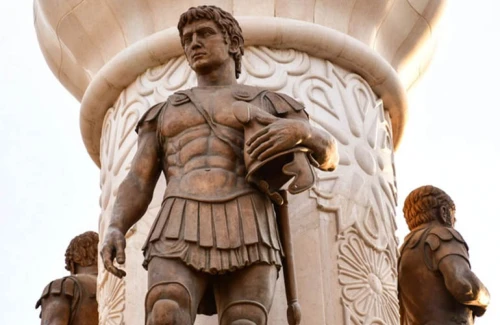
Alexander the Great, renowned for his military prowess and strategic brilliance, faced numerous adversaries throughout his conquests, but one notable opponent was King Porus of Paurava.
Advertisement
This clash occurred during Alexander’s ambitious campaign into northern India, following his triumphant conquest of the Persian Empire.
The encounter unfolded on the banks of the Hydaspes River, now known as the Jhelum, in the Punjab region. King Porus, recognizing the threat posed by Alexander’s advancing forces, strategically positioned his army to block the Macedonian king at a ford on the river.
The forces were relatively evenly matched in numerical terms, but Porus held a formidable advantage with 200 war elephants, a force to be reckoned with on the ancient battlefield.
In a tactical move, Alexander divided his army, leaving a smaller force under Craterus to face Porus at the ford, while he led the majority of his troops to cross a second ford about 17 miles (27 km) away. This maneuver showcased Alexander’s flexibility and strategic acumen.
As Porus learned of Alexander’s movement over the river, he decided to take the initiative and marched to confront the Macedonian forces. Placing his cavalry on the flanks and infantry in the center, with the war elephants positioned at the front, Porus prepared for a formidable defense.
Alexander, in response, organized his heavy infantry into a phalanx at the center, led the right-wing cavalry personally, and sent Coenus with the left-wing cavalry on a wide, outflanking maneuver behind a hill.
Advertisement

The engagement commenced with the Macedonian phalanx facing the charging elephants in the center. The Indian elephants posed a significant threat, almost breaking the Macedonian phalanx, but the disciplined Macedonian soldiers eventually repelled them.
This success, however, led them to face the resilient Indian infantry. While Alexander attempted to find a gap to exploit with his cavalry on the right, Coenus, executing the outflanking maneuver, returned to the battlefield at the rear of the Indian forces.
This decisive move enabled Alexander to defeat the Indian cavalry and encircle the infantry, turning the tide of the battle. Facing encirclement and recognizing the changing dynamics of the battlefield, Porus reformed his infantry into a defensive block.
In a testament to Alexander’s military acumen, Porus then offered to surrender, seeking generous terms. In a display of magnanimity, Alexander agreed to Porus remaining as the king of Paurava but imposed a tribute on the defeated ruler.
In terms of casualties, the Macedonians suffered approximately 1,000 losses out of their 41,000-strong army, highlighting the intensity of the conflict. On the Indian side, casualties were more substantial, with 12,000 soldiers reported dead and 9,000 captured out of a force totaling 50,000.
The Battle of the Hydaspes River became a significant chapter in Alexander’s conquests, underscoring both his military genius and the challenges he faced as he expanded his empire into the vast territories of the Indian subcontinent.
Leave a Reply