

Bartolomé Esteban Murillo, a luminary of Spanish Baroque painting, has left an enduring legacy with his religious works and captivating portraits of everyday life. While he is celebrated for his depictions of the divine, Murillo’s artistic journey is equally marked by his portrayals of contemporary women and children. This article explores the inception of Murillo’s illustrious career and traces his evolution into one of the most influential painters of 17th-century Spain.
Advertisement

Britannica
Childhood and Early Life:
Born in late December 1617, Murillo was baptized on January 1, 1618, in Seville, Spain. His parents, Gaspar Esteban and María Pérez Murillo, passed away when he was still a child, making him a ward of his older sister Ana and her husband, Juan Agustín Lagares. Growing up in the vibrant city of Seville, Murillo’s early exposure to its diverse influences shaped his artistic sensibilities.
Formative Years and Artistic Beginnings:
Murillo’s entry into the world of art is shrouded in limited documentation, but it is believed that he commenced his artistic studies around the age of 15. At this juncture, he received a license for passage to America with his family in 1633. Murillo’s artistic foundations were laid in the workshop of Juan del Castillo, his uncle, and godfather, a skilled painter in his own right. Inspired by Castillo’s style, Murillo’s early works bore the influence of Francisco de Zurbarán, Jusepe de Ribera, and Alonso Cano.
Madrid Sojourn and Artistic Development:
In 1642, at the age of 26, Murillo purportedly traveled to Madrid, where he encountered the works of Diego Velázquez and Francisco de Palacios. The visual richness and softly modeled forms in his subsequent works reflect these influences. While claims of Murillo’s travels to Madrid and even Italy have been debated, art historian Antonio Palomino asserted that Murillo’s skills were honed through meticulous study of the natural world within the confines of his room.
https://www.youtube.com/watch?v=CkvAIXkNdKU
Marriage and Major Commissions:
In 1645, Murillo returned to Seville and married Beatriz Cabrera y Villalobos, marking the beginning of a prolific period in his life. The same year, he received a significant commission to paint eleven canvases for the convent of San Francisco in Seville, showcasing various stories of Franciscan saints. This project was the springboard for Murillo’s career, solidifying his reputation as a masterful storyteller through art.

Later Years and Legacy:
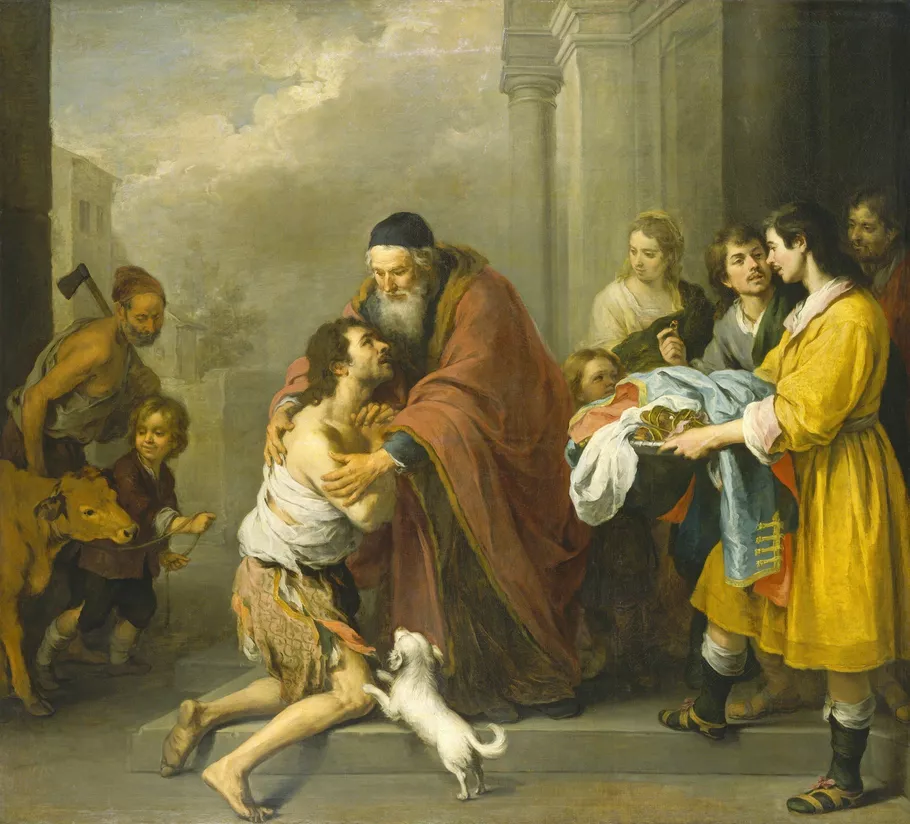
Murillo’s career witnessed a flourishing period, with notable works such as “The Virgin and Child” and “The Immaculate Conception.” Despite another stint in Madrid from 1658 to 1660, he returned to Seville, leaving an indelible mark as one of the founders of the Academia de Bellas Artes in 1660. Murillo’s legacy extends beyond his death in 1682, with numerous pupils and followers perpetuating his style. His influence reached far and wide, resonating with artists like Gainsborough and Greuze.

Brooklyn Museum
Bartolome Esteban Murillo’s artistic journey is a captivating narrative of talent, resilience, and a deep connection to his surroundings. From the streets of Seville to the halls of European art, Murillo’s paintings continue to captivate audiences, offering glimpses into both the divine and the everyday. His ability to weave stories through brushstrokes has secured him a revered place in the annals of art history, making Murillo a true master of his craft.
Advertisement
Bartolome Esteban Murillo’s artistic journey is a captivating narrative of talent, resilience, and a deep connection to his surroundings. From the streets of Seville to the halls of European art, Murillo’s paintings continue to captivate audiences, offering glimpses into both the divine and the everyday. His ability to weave stories through brushstrokes has secured him a revered place in the annals of art history, making Murillo a true master of his craft.
Bartolomé Esteban Murillo, the renowned Spanish Baroque painter, left a lasting mark on art history with his prolific body of work. Born in late December 1617 or possibly early January 1618 in Seville, Murillo displayed his artistic prowess at a young age, setting the stage for a career that would span various subjects and styles.
Early Life and Formative Years
Little is known about Murillo’s early life, but he began his artistic journey in Seville under the guidance of his uncle and godfather, Juan del Castillo. His early works bore the influence of painters like Francisco de Zurbarán, Jusepe de Ribera, and Alonso Cano, reflecting a strong realist approach. Murillo’s talent developed over time, influenced by the rich artistic environment of Seville and the broader European art scene.
Career Highlights
In 1642, at the age of 26, Murillo is believed to have traveled to Madrid, where he likely encountered the works of Velázquez and Francisco de Palacios. His artistry evolved, showcasing rich colors and softly modeled forms. After returning to Seville in 1645, he married Beatriz Cabrera y Villalobos and received a major commission to paint eleven canvases for the convent of San Francisco. This marked the beginning of a remarkable career characterized by religious works, portraits, and scenes of everyday life.
Murillo’s career flourished during his period of greatest activity from 1658 to 1660, where he played a key role in founding the Academia de Bellas Artes in Seville. His notable works include altarpieces for the Augustinian monastery and paintings for Santa María la Blanca. Sadly, his life was cut short when he fell from a scaffold while working on a fresco in Cádiz, leading to his death in 1682.
Legacy and Influence
Murillo’s legacy extends beyond his lifetime. He had numerous pupils and followers, and his paintings were widely imitated, solidifying his reputation in Spain and gaining fame across Europe. Before the 19th century, Murillo was arguably the most well-known Spanish artist, with influences reaching artists like Gainsborough and Greuze.

Counting Murillo’s Paintings
The exact number of paintings Murillo created remains elusive. His extensive body of work encompasses religious themes, portraits, and scenes of everyday life. Some of his notable paintings include “The Holy Family with a Little Bird,” “Two Women at a Window,” and “The Adoration of the Shepherds.”
While it’s challenging to pinpoint an exact number due to the lack of comprehensive records, art historians and experts continue to uncover and attribute works to Murillo. Museums such as the Museo del Prado in Madrid, the Hermitage Museum in Saint Petersburg, and the Wallace Collection in London house some of his masterpieces.
Murillo’s impact on the art world endures, making it challenging to quantify the sheer breadth of his artistic output. As scholars and enthusiasts delve deeper into archives and collections, the number of recognized Murillo paintings may continue to evolve, ensuring the artist’s enduring legacy in the world of art.
Leave a Reply