
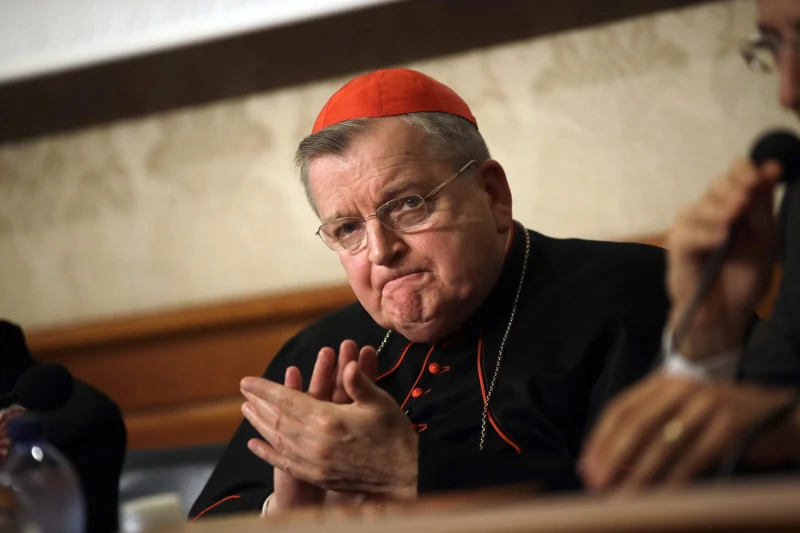
Cardinal Raymond Leo Burke stands not only as an esteemed prelate within the Catholic Church but also as a distinguished canon lawyer, shaping the discourse of the Church with his expertise in canonical matters.
Advertisement
Widely perceived as a voice of traditionalism, Burke has solidified his reputation as a conservative leader during his tenures in La Crosse and St. Louis.
Born into a world where the intricate rules of canon law hold profound significance, Cardinal Burke’s journey into the realm of theology and canon law commenced in the late 1960s.
From 1968 to 1971, he undertook rigorous studies at the Catholic University of America in Washington, D.C., as a Basselin scholar. During this period, he earned a Bachelor of Arts degree in 1970 and a Master of Arts degree in 1971, both in philosophy, laying the groundwork for his intellectual prowess.
However, Burke’s educational odyssey did not conclude there. Driven by a fervent dedication to his faith and a desire for a deeper understanding of the Church’s legal framework, he embarked on studies for the priesthood at the Pontifical Gregorian University in Rome.
Advertisement

Between 1971 and 1975, Burke immersed himself in the rich tapestry of theological studies, earning a Bachelor of Sacred Theology degree and another Master of Arts degree.
June 29, 1975, marked a significant moment in Burke’s life and the Church’s history as Pope Paul VI ordained him to the priesthood in the majestic St. Peter’s Basilica. Armed with a profound knowledge of philosophy, theology, and canon law, Burke commenced his journey as a clergyman.
As a canon lawyer, Cardinal Burke has played a pivotal role in shaping the Church’s interpretation and application of canon law. His adherence to traditionalist values and conservative principles has positioned him as a beacon of canonical wisdom.
Leave a Reply